Relevance for Reproductive Medicine and Pregnancy – Focus on Printer-Emitted Particles (PEPs)

Indoor Air Pollution – Overlooked Sources

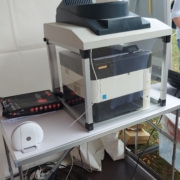
Indoor air pollution is often underestimated, yet one of its most overlooked sources is the everyday laser printer. During operation, laser printers emit engineered nanoparticles—so-called printer-emitted particles, or PEPs—from nano-enabled toners. These emissions are not trivial. Studies show that in offices and even in homes, particle concentrations can reach levels comparable to those near heavily trafficked urban roads or cigarette smoke in enclosed spaces [1,2]. Weiterlesen

Post-Event Report on Filtration Hour (March 2026 CCME)

Entscheidungsträger im Gesundheitswesen und Spezialisten für Qualitätskontrolle im Bereich HLK Normungs- und Zertifizierungsstellen Fachärzte für Reproduktionsmedizin HVAC-und Filtrationsfachleute Eigentümer und Investoren Technische Vertreter von Fruchtbarkeitskliniken und anderen Gesundheitseinrichtungen Hersteller von IVF-Technologie und -Ausrüstung Architekten im Gesundheitswesen MEP-Berater und -Bauunternehmer Allgemeine Berater und Bauunternehmer Fachleute für Facility Management

SYMPOSIUM-VORSITZENDER: DR. IYAD AL-ATTAR, UNABHÄNGIGER BERATER FÜR LUFTFILTRATION UND INNENRAUMLUFTQUALITÄT

SESSION 1: Die Auswirkungen von Luftschadstoffen auf die menschliche Fruchtbarkeit

Schwerpunkt: Untersuchung der epidemiologischen und biologischen Zusammenhänge zwischen schlechter Luftqualität, städtischen Umgebungen und der reproduktiven Gesundheit.

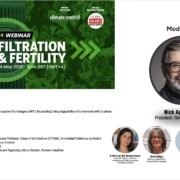
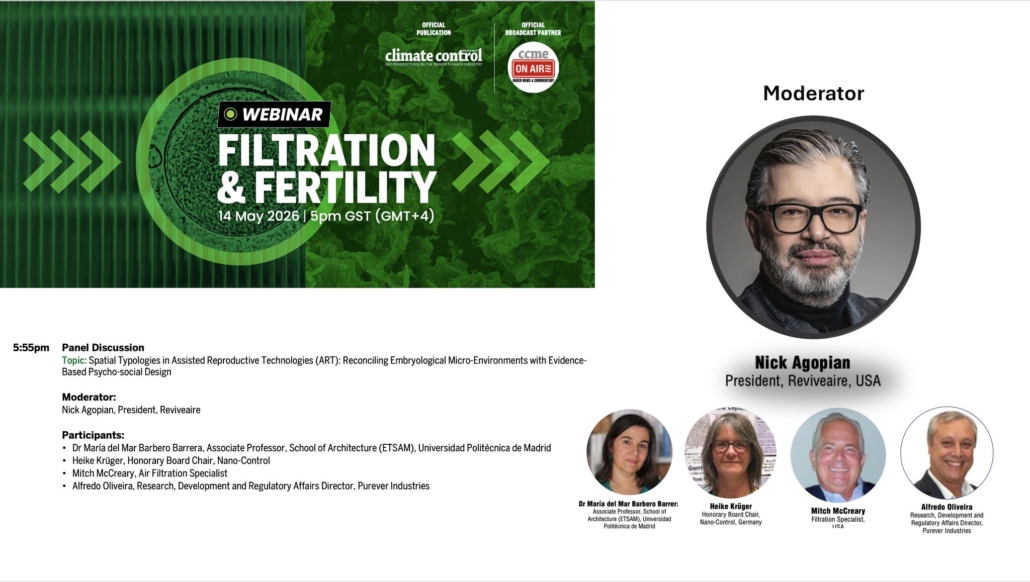
17:55 Uhr Podiumsdiskussion

Thema: Räumliche Typologien in der assistierten Reproduktionstechnologie (ART): Die Vereinbarkeit embryologischer Mikroumgebungen mit evidenzbasiertem psychosozialem Design

Moderator: Nick Agopian, Präsident, Reviveaire

Teilnehmer:

  • Dr. María del Mar Barbero Barrera, außerordentliche Professorin, Fakultät für Architektur (ETSAM), Universidad Politécnica de Madrid
  • Heike Krüger, Ehrenvorsitzende des Vorstands, Nano-Control
  • Mitch McCreary, Spezialist für Luftfilterung
  • Alfredo Oliveira, Direktor für Forschung, Entwicklung und regulatorische Angelegenheiten, Purever Industries


Heike Krüger, Chairwoman of the nano-Control, Internationale Stiftung, is sounding the alarm on a „silent epidemic“ hiding in our offices: ultrafine particles from laser printers.

The Invisible Reality:

  • Printing just one page can release billions of particles into the air.
  • These pollutants can reach every cell in the human body, including the brain.
  • Studies show that 90% of affected individuals report respiratory issues.

Heike is calling for international standards to limit these particles to below 1,000 per cubic centimeter, a vital move to protect us in the indoor spaces where we spend 90% of our lives.

„I have a dream that one day the air we breathe indoors will be safe and clean.“ — Heike Krüger

Für weitere Informationen klicken Sie hier.

Heike Krüger took part in the WFI Filtration Hour and was impressed by the passion and contributions of the outstanding panellists. This discussion was a wonderful opportunity to draw attention to underestimated topics.

She was delighted to be able to present the topic to this outstanding group.

Her conclusion:

The issue of indoor air pollution is very complex. The first important step is to bring all relevant issues to the table in order to develop concepts from experts for healthy indoor air that we can rely on – whatever it takes!

Full Webinar Recording | Filtering the Air Quality Noise (Filtration Hour)

Weiterlesen

Global Pledge for Healthy Indoor Air

We declare, for the first time as a global community, that clean indoor air is a fundamental human right for protecting health and safeguarding well-being. Poor air quality in indoor environments – where populations spend up to 90 percent of their time – contributes to respiratory disease (including
asthma and lung cancer), heart disease, infectious disease transmission, and cognitive impairment, in addition to potential impacts from carcinogens. All people are impacted by poor indoor air quality.
In 2000, a World Health Organization working group concluded „everyone has a right to healthy indoor air”1 and in recent years, both the United Nations (2022)2 and the World Health Organization (2021)3 recognized clean air as a human right. This Global Pledge builds on those pioneering steps
to help galvanize global action explicitly on indoor air quality. Furthermore, the importance of healthy indoor air is recognized in the context of the United Nations’ Sustainable Development Goals (SDGs), particularly SDG 3 (Good Health and Well-Being) and SDG 11 (Sustainable Cities and Communities). Collaboration amongst the broad suite of stakeholders involved in addressing indoor air quality also honors SDG 17 (Partnerships for the Goals).
The 2025 launch of the Global Pledge for Healthy Indoor Air represents a landmark moment, signaling the first international movement to prioritize healthy indoor air for all. We invite governments, non-governmental organizations, cities, universities, schools, healthcare facilities, professional associations, advocacy organizations, businesses, and community groups to join this Pledge. Together, we can build a world where everyone, everywhere, breathes healthy indoor air. Weiterlesen

Gesunde Innenraumluft – A Global Call to Action

Hamburg, 25.09.2025 Saubere Atemluft ist lebenswichtig. Wir atmen jeden Tag rund 20.000-mal ein und aus – ohne darüber nachzudenken. Doch dabei nehmen wir auch Stoffe auf, die uns schaden.

Was kaum jemand weiß: In Innenräumen werden Milliarden Mikro- und Nanoplastik-Partikel mit Metallen und Chemikalien freigesetzt, aus Bürogeräten, wie Laserdrucker, Kopierer oder 3D-Drucker – schon beim Drucken einer einzigen Seite. Diese ultrafeinen Partikel (UFP) sind unsichtbar und gesundheitsschädlich, lungengängig, und sie überwinden all unsere Barrieren. UFP sind bisher nicht reguliert. Arbeitgeber, Schulen, Krankenhäuser oder Verwaltungen setzen solche Geräte ein, ohne die Risiken zu kennen.

Beim CO₂ haben wir gelernt, zu handeln. Aber bei Belastungen der Innenraumluft durch vermeidbare Partikel und Schadstoffe hinken wir weit hinterher. Genau hier möchte ich ansetzen. Weiterlesen

The air we breathe indoors can be far more polluted than the air outside, yet it’s an issue that often goes unnoticed. The nano-Control, International Foundation and the Global Open Air Quality Standards (GO AQS) initiative are stepping up to address this critical challenge by announcing a new collaboration focused on the health risks posed […]

Heike Krüger, Vorstandsvorsitzende (Hoya) und Stefan Hausmann, Stiftungsratsvorsitzender (Alfeld) der gemeinnützigen Stiftung nano-Control (Stiftungssitz in Hamburg, Verwaltungssitz in Hoya) folgten einer Einladung der Organisatoren der ETH NPC25 in die Schweiz.

Im vergangenen Jahr wurde die ehrenamtliche Stiftung als assoziiertes Mitglied bei der VERT Association in der Schweiz aufgenommen. So entstanden die neuen internationalen Kontakte zu Experten aus dem Bereich Technologie zur Emissionsminderung von Verbrennungsmotoren, ein internationaler Verband von Herstellern von Emissionsminderungssystemen (z.B. Messergeräte, Filter, Reinigungsanlagen), die zur Teilnahme an der ETH NPC25 führten.

Experten aus Forschung, Industrie und Regierung kamen bei der Konferenz aus der ganzen Welt zusammen, um Themen im Zusammenhang mit Nanopartikeln, bezüglich der Quellen, ihrer Auswirkungen auf Gesundheit und Umwelt sowie neuer Technologien zur Eindämmung zu diskutieren.

Weiterlesen