Beiträge

We are thrilled to announce the publication of the article in Filtration News:

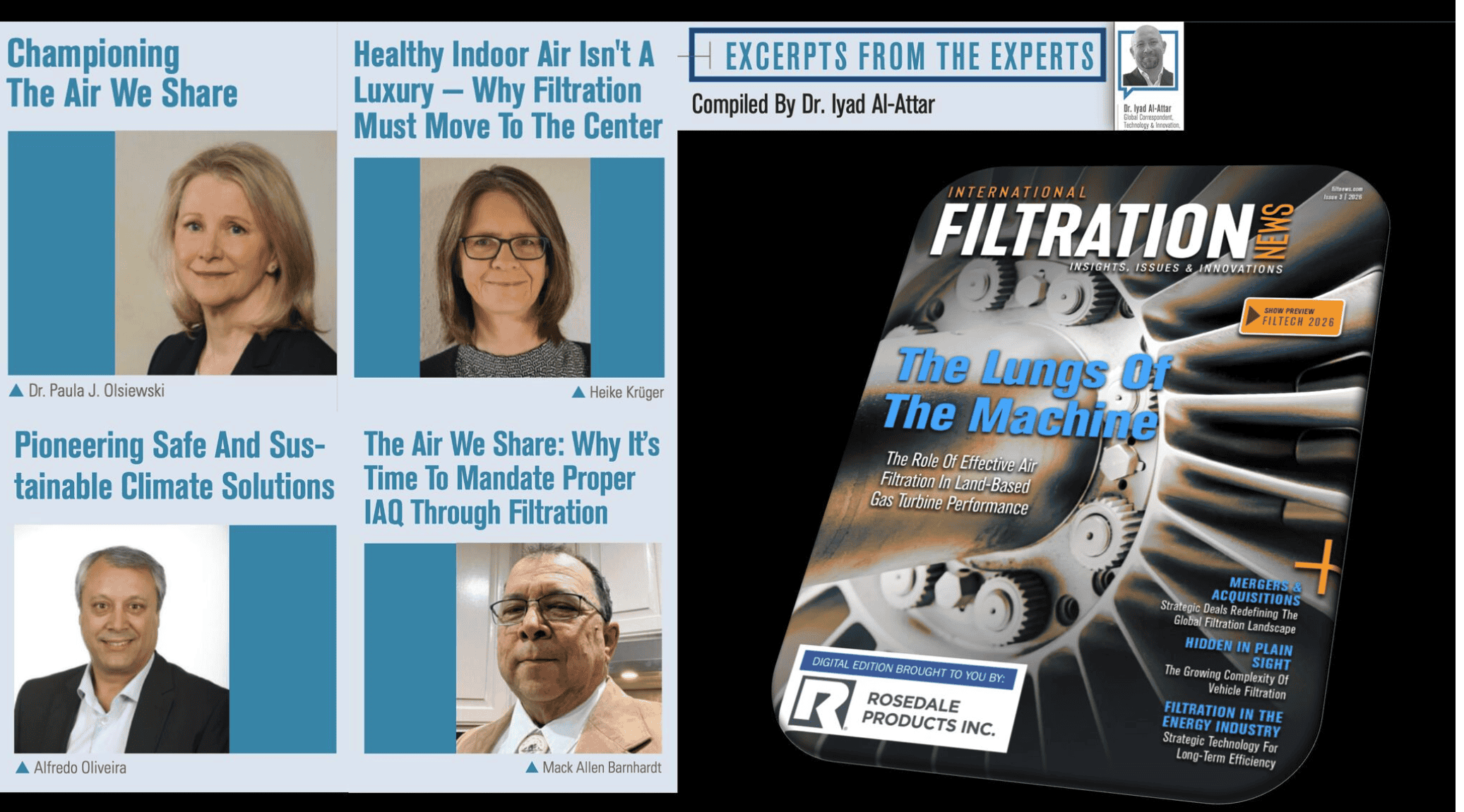
Healthy Indoor Air Isn´t A Luxury – Why Filtration Must Move To The Center

Author Heike Krüger, nano-Control Foundation

Healthy Indoor Air Isn´t A Luxury – Why Filtration Must Move To The Center

We are pleased to share the LinkedIn Presentation from

Dr. Iyad Al-Attar
Visiting Academic Fellow – School of Aerospace, Transport and Manufacturing at Cranfield University
Vereinigtes Königreich

🤝 In our pursuit of atmospheric integrity, these leaders are redefining how we perceive and protect the air we breathe.“

🟢 Dr Paula Olsiewski:
Championing the air we share

🟢 Heike Krüger
#Healthy #indoor air isn’t a luxury- Why #filtration must move to the center

🟢 Alfredo Oliveira
Pioneering #safe and #sustainable #climate solutions

🟢 Mack Barnhardt
The air we share: why it’s time to mandate proper #IAQ through filtration

👉 Read the full script – page 28, go the 🏃‍➡️ #extra #mile with the International Filtration News::

Healthy Indoor Air Isn´t A Luxury – Why Filtration Must Move To The Center

#future #innovation #sustainability #urbanization #data #energy #public #health #wellbeing

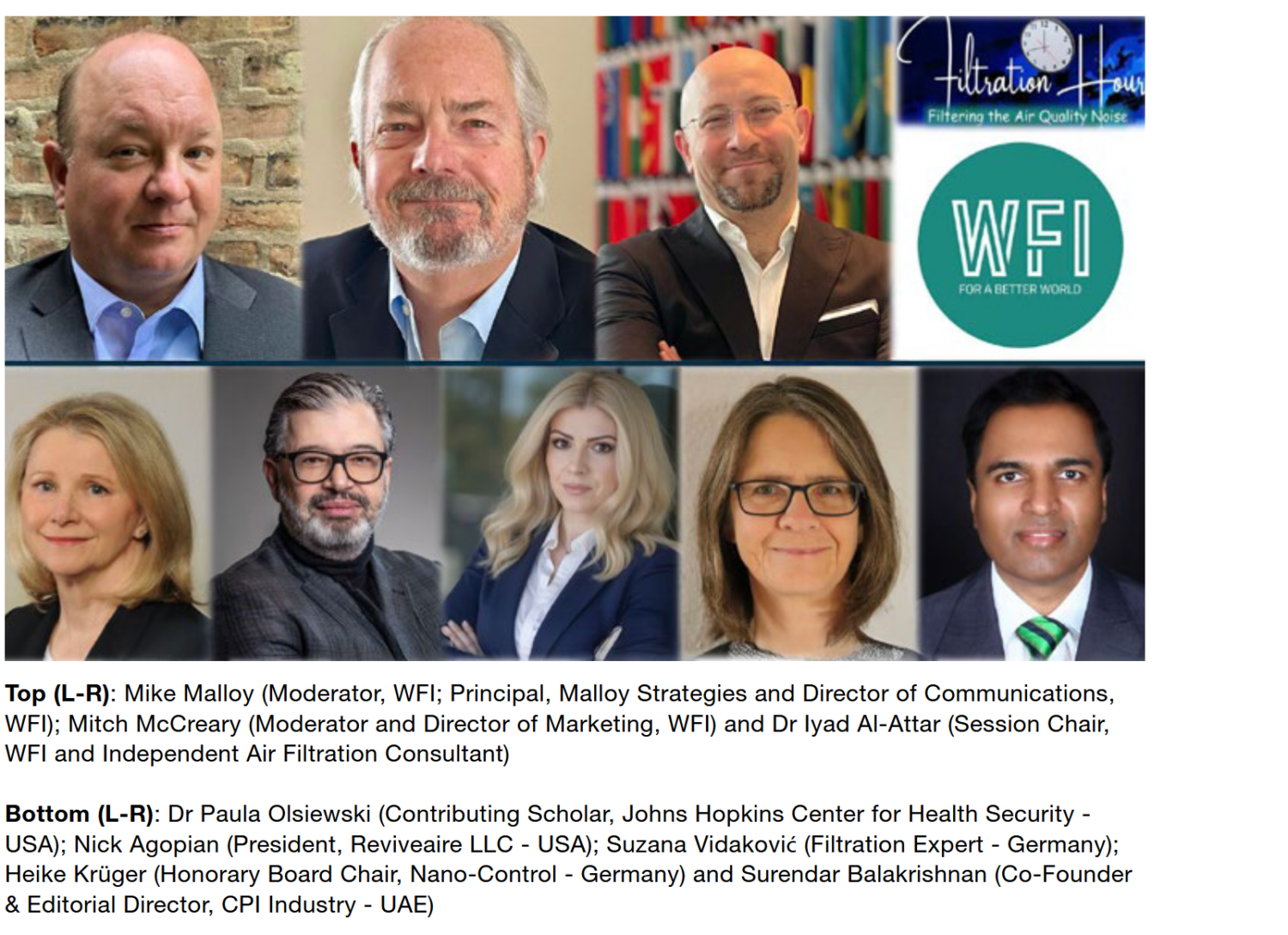
Link FILTRATION HOUR CALLS FOR GLOBAL ALIGNMENT ON IAQ GOVERNANCE


WFI Post-Event Report on Filtration Hour

28 MARCH 2026
FILTRATION HOUR CALLS FOR GLOBAL ALIGNMENT ON IAQ GOVERNANCE

World Filtration Institute-hosted webinar highlights need for standards, data integrity and health-first approach to air quality management

By Karu Suren | Associate Editor, Climate Control Middle East

POST-EVENT REPORT FILTRATION HOUR, the webinar by the World Filtration Institute (WFI), on February 19, underscored the growing complexity surrounding Indoor Air Quality (IAQ), and called for a transition towards more structured governance,
standardisation and accountability. Held under the theme, ‘Filtering theAir Quality Noise’, the event, in panel discussion format, brought together specialists from academia, industry and media to examine the challenges posed by fragmented data, inconsistent
standards and limited public awareness.

Weiterlesen

Clean indoor air with real-time measurements, pollution avoidance, intelligent filtration systems, continuous documentation and evaluation of atmospheric memory

Healthy indoor air is not a luxury—it is essential. We spend up to 90% of our lives inside buildings, yet indoor air can be significantly more polluted than outdoor air. The good news: unlike ambient pollution, indoor air quality is largely within our control. Filtration, when combined with measurement and intelligent systems, offers one of the most effective levers for immediate improvement. Weiterlesen

Heike Krüger, Chairwoman of the nano-Control, Internationale Stiftung, is sounding the alarm on a „silent epidemic“ hiding in our offices: ultrafine particles from laser printers.

The Invisible Reality:

  • Printing just one page can release billions of particles into the air.
  • These pollutants can reach every cell in the human body, including the brain.
  • Studies show that 90% of affected individuals report respiratory issues.

Heike is calling for international standards to limit these particles to below 1,000 per cubic centimeter, a vital move to protect us in the indoor spaces where we spend 90% of our lives.

„I have a dream that one day the air we breathe indoors will be safe and clean.“ — Heike Krüger

Für weitere Informationen klicken Sie hier.

We are participating because this is where experts from all over the world from across different disciplines meet to discuss the topic of indoor air quality.

VERT FORUM 2026 – March 19th, 2026
– Indoor Air Quality

VERT FOCUS Day March 20th, 2026
– NPTI / PN – Exhibition
Location: METAS, Bern Switzerland


Heike Krüger, Chairwoman of the nano-Control, Internationale Stiftung, is sounding the alarm on a „silent epidemic“ hiding in our offices: ultrafine particles from laser printers.

The Invisible Reality:

  • Printing just one page can release billions of particles into the air.
  • These pollutants can reach every cell in the human body, including the brain.
  • Studies show that 90% of affected individuals report respiratory issues.

Heike is calling for international standards to limit these particles to below 1,000 per cubic centimeter, a vital move to protect us in the indoor spaces where we spend 90% of our lives.

I have a dream that one day the air we breathe indoors will be safe and clean. — Heike Krüger 

Global Pledge for Healthy Indoor Air

We declare, for the first time as a global community, that clean indoor air is a fundamental human right for protecting health and safeguarding well-being. Poor air quality in indoor environments – where populations spend up to 90 percent of their time – contributes to respiratory disease (including
asthma and lung cancer), heart disease, infectious disease transmission, and cognitive impairment, in addition to potential impacts from carcinogens. All people are impacted by poor indoor air quality.
In 2000, a World Health Organization working group concluded „everyone has a right to healthy indoor air”1 and in recent years, both the United Nations (2022)2 and the World Health Organization (2021)3 recognized clean air as a human right. This Global Pledge builds on those pioneering steps
to help galvanize global action explicitly on indoor air quality. Furthermore, the importance of healthy indoor air is recognized in the context of the United Nations’ Sustainable Development Goals (SDGs), particularly SDG 3 (Good Health and Well-Being) and SDG 11 (Sustainable Cities and Communities). Collaboration amongst the broad suite of stakeholders involved in addressing indoor air quality also honors SDG 17 (Partnerships for the Goals).
The 2025 launch of the Global Pledge for Healthy Indoor Air represents a landmark moment, signaling the first international movement to prioritize healthy indoor air for all. We invite governments, non-governmental organizations, cities, universities, schools, healthcare facilities, professional associations, advocacy organizations, businesses, and community groups to join this Pledge. Together, we can build a world where everyone, everywhere, breathes healthy indoor air. Weiterlesen

Die DGUHT e.V. gibt uns die Möglichkeit unser Thema der Öffentlichkeit vorzustellen.

Heike Krüger (nano-Control): Laser- & 3D-Drucker: Belastung der Innenraumluft durch ultrafeine Partikel (PM0.1)

Studien, Praxiserfahrungen und alltagstaugliche Tipps – verbunden mit klaren Forderungen nach Grenzwerten für saubere Atemluft.

Freuen Sie sich auf ein spannendes Programm mit hochkarätigen Referentinnen und Referenten bei der Deutschen Gesellschaft für Umwel und Humantoxikologie, der DGUHT e.V. , die aktuelle Themen rund um Umwelt, Gesundheit und Technik beleuchten.

Unsichtbare Gefahr im Innenraum – Zeit zur Schaffung wissenschaftliche Evidenz zur Luftverschmutzung durch ultrafeine Partikel und deren Wirkung auf die Gesundheit

Seit über drei Jahrzehnten kämpfen Menschen, die von den Emissionen von Laserdruckern und Kopierern betroffen sind, um Anerkennung, Verständnis und Schutz. Was als Gesundheitsbeschwerden Einzelner begann, hat sich zu einem bedeutenden Problem der öffentlichen Gesundheit entwickelt – gestützt durch Daten, Fallberichte und wissenschaftliche Erkenntnisse.

Über viele Jahre hinweg hat sich gezeigt, dass Büroumgebungen, die harmlos erschienen, eine zentrale Rolle bei diesem Problem spielen. Tausende haben sich bei nano-Control, Internationale Stiftung immer wieder mit ähnlichen Symptomen gemeldet. Alle waren den Emissionen aus Bürogeräten, wie Laserdrucker und Kopierer ausgesetzt und sahen dies als die Ursache ihrer Gesundheitsbeschwerden.

Die ehrenamtliche Stiftung nano-Control hat sich von einer Bürgerinitiative zu einer Wissens- und Interessenvertretungsplattform entwickelt. Weiterlesen

Origin, effect and health relevance – focus on laser printer emissions

Aerosols – definition and origin in the air we breathe

Aerosols: complex mixtures of solid and/or liquid particles, finely dispersed in a gas – typically air

Formation in the ambient air – indoors and outdoors: both through natural processes (e.g. volcanic eruptions, pollen count, sea spray) and human activities such as industry, transport, laser printing, 3D printing and household processes.

Weiterlesen